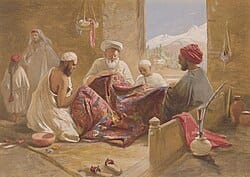
Cashmere wool, usually simply known as cashmere, is a fiber obtained from cashmere goats, pashmina goats, and some other breeds of goat. It has been used to make yarn, textiles and clothing for hundreds of years. Cashmere is closely associated with the Kashmir shawl, the word “cashmere” deriving from an anglicization of Kashmir, when the Kashmir shawl reached Europe in the 19th century. Both the soft undercoat and the guard hairs may be used; the softer hair is reserved for textiles, while the coarse guard hair is used for brushes and other non-apparel purposes. Cashmere is a hygroscopic fiber, absorbing and releasing water from the air based on the surrounding environment. This helps regulate the body in both warm and cool temperatures.
A number of countries produce cashmere and have improved processing techniques over the years, but China and Mongolia are two of the leading producers as of 2019. Afghanistan is ranked third.
Some yarns and clothing marketed as containing cashmere have been found to contain little to no cashmere fiber, so more stringent testing has been requested to ensure items are fairly represented. Poor land management and overgrazing to increase production of the valuable fiber has resulted in the decimation and transformation of grasslands into deserts in Asia, increasing local temperatures and causing air pollution which has traveled as far as Canada and the United States.
Sources
Historically, in the Western scientific community, fine-haired Cashmere goats have been called Capra hircus, as if they were a subspecies of the domestic goat Capra hircus. However, they are now more commonly considered part of the domestic goat subspecies Capra aegagrus hircus or the alternate version Hircus Blythi Goat. Cashmere goats produce a double fleece that consists of a fine, soft undercoat or underdown of hair mingled with a straighter and much coarser outer coating of hair called guard hair. This undercoat is grown in the winter as a way to keep the goat warm in colder months. For the fine underdown to be sold and processed further, it must be de-haired. De-hairing is a mechanical process that separates the coarse hairs from the fine hair. After de-hairing, the resulting cashmere is ready to be dyed and converted into textile yarn, fabrics and garments.[citation needed] De-hairing is made slightly easier by removing the undercoat by hand, rather than shaving the entire coat. This process takes much longer to remove the cashmere, but produces a much finer, higher quality fiber.
Gathering
Cashmere wool is collected during the spring moulting season when the goats naturally shed their winter coat. In the Northern Hemisphere, the goats moult as early as March and as late as May.
In some regions, the mixed mass of down and coarse hair is removed by hand with a coarse comb that pulls tufts of fiber from the animal as the comb is raked through the fleece. Fiber collected by this method has a higher yield of pure cashmere, after it has been washed and dehaired, than does fiber produced by shearing. The long, coarse guard hair is then typically clipped from the animal and is often used for brushes, interfacings and other non-apparel uses. Animals in Iran, Afghanistan, New Zealand, and Australia are typically shorn of their fleece, resulting in a higher coarse hair content and lower pure cashmere yield. In the United States, the most popular method is combing. The process takes up to two weeks, but with a trained eye for when the fiber is releasing, it is possible to comb the fibers out in about a week. The term “baby cashmere” is used for fibers harvested from younger goats, and is reputed to be softer.
Production
China is the largest producer of raw cashmere, with production estimated to be 19,200 metric tons (in hair) per year in 2016. Mongolia is second with 8,900 tons (in hair) as of 2016,[8] while Afghanistan, Iran, Turkey, Kyrgyzstan[9] and other Central Asian republics produce lesser amounts. The annual world raw production is estimated to be between 15,000 and 20,000 tons (13,605 and 18,140 tonnes) (in hair). Pure cashmere, resulting from removing animal grease, dirt and coarse hairs from the fleece, is estimated at 6,500 tons (5,895 tonnes). Ultra-fine Cashmere or Pashmina is still produced by communities in Kashmir but its rarity and high price, along with political instability in the region, make it very hard to source and to regulate quality. It is estimated that the average yearly production per goat is 150 grams (0.33 lb).
Pure cashmere can be dyed and spun into yarns and knitted into jumpers (sweaters), hats, gloves, socks and other clothing, or woven into fabrics and then cut and assembled into garments such as outer coats, jackets, trousers (pants), pajamas, scarves, blankets, and other items. Fabric and garment producers in Scotland, Italy, and Japan have long been known as market leaders. Cashmere may also be blended with other fibers to bring the garment cost down, or to gain their properties, such as elasticity from wool, or sheen from silk.
The town of Uxbridge, Massachusetts, in the United States was an incubator for the cashmere wool industry. It had the first power looms for woolens and the first manufacture of “satinets”. Capron Mill had the first power looms, in 1820. It burned on July 21, 2007, in the Bernat Mill fire.
In the United States, under the U.S. Wool Products Labeling Act of 1939, as amended, (15 U. S. Code Section 68b(a)(6)), a wool or textile product may be labelled as containing cashmere only if the following criteria are met:
such wool product is the fine (dehaired) undercoat fibers produced by a cashmere goat (Capra hircus laniger);
the average diameter of the fiber of such wool product does not exceed 19 microns; and
such wool product does not contain more than 3 percent (by weight) of cashmere fibers with average diameters that exceed 30 microns.
the average fiber diameter may be subject to a coefficient of variation around the mean that shall not exceed 24 percent.